
Boiling milk should be an easy job - pour it in the saucepan, turn the heat on and bring to boil! But, no matter how careful you are it's also really easy to let the milk to boil a tad too much and then you end up with more milk on your cooker than in your saucepan. And it's not very pleasant to clean either!
So, how do you stop milk boiling over and it is even possible?
Well, the good news is that, whilst you still need to be a bit careful when you are boiling your milk, it's possible to prevent it from boiling over and getting stuck to your stove.
Over the years, I've tried different ways to make sure my milk doesn't overboil and finally worked out my 9 tried and tested tips that I'm happy to share with you today.
PIN TO KEEP FOR LATER

Here are my top tips on how to stop milk boiling over
1. Use wooden spoon
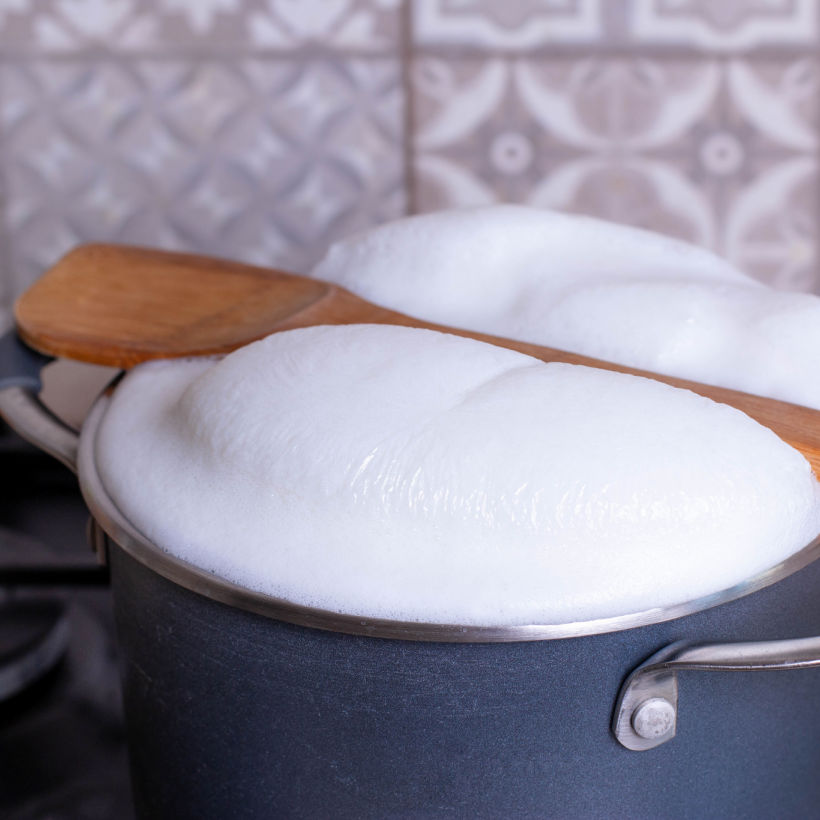
This is super easy to do and it's actually really effective. All you need to do is to pour milk into a saucepan and slowly bring to the boil. Place wooden spoon across the top of the saucepan
The wooden spoon will stop and break up the milk foam bubbles, which then helps to disperse them and stop them from running over the top of your saucepan.
MORE COOKING TIPS
- Step by step guide on how to freeze gumbo >>
- Tried & tested tips on how to freeze gravy >>
- How best to freeze portobello mushrooms >>
2. Use large saucepan
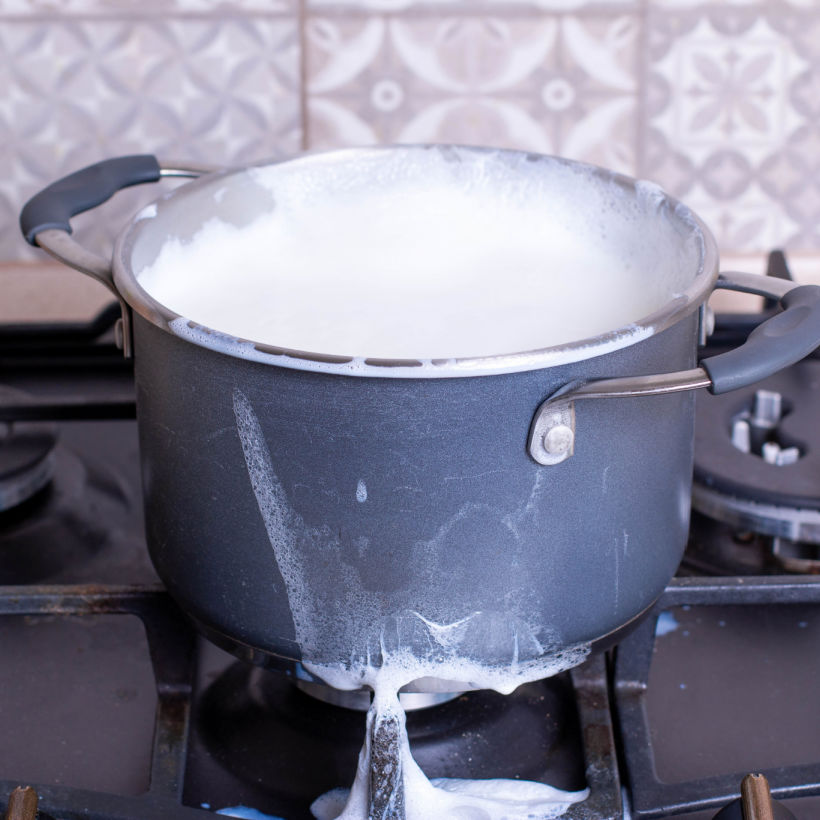
Another simple tip, that I've learned the hard way. If you use small saucepan your milk will overboil no matter what, so make sure that you use one that leaves at least 7-10 cm gap from the top.
This way, you are more likely to catch your milk running over, than if you have small saucepan. This really works every time.
3. Use a heavy-bottomed saucepan
Whilst you can boil milk in any kind of saucepan, I tend to have one just for milk and use a very heavy saucepan.
A heavy-bottomed pan ensures even heat distribution, which helps prevent the milk from scorching and boiling over. It's also because it takes a little longer for the milk to boil (or overboil) so you get a chance to catch it before it spills everywhere.
MORE COOKING TIPS
- How to bake perfect level cake >>
- How to stop porridge overflowing >>
- How to prevent bread spreading >>
4. Stir your milk continuously
Yup, I get it! Watching milk boil is not my kind of entertainment either, but believe me, if you stay with your milk, your mill will stay with you!
Once your milk starts to get warmer, stir it slowly with a wooden spoon and carry on until it boils. The gentle stirring works in the same way as the wooden spoon on the top the saucepan. By stirring your milk you are continuously breaking the milk foam bubbles and this helps to keep them down.
Plus, if you are watching your milk, you can switch it at the right time, so it never boils over.
5. Grease the saucepan rim
You have to be a little bit careful with this one, as you don't want to add too much flavour into your milk by adding too much butter or oil, but this method also works well.
What you need to do is to rub a small amount of butter or oil around the rim of the pot to prevent the milk from boiling over. This creates a barrier that helps control the foam and once the milk foam gets to the grease it will start to disperse. This method works best if you boil your milk carefully and slowly.
MORE COOKING TIPS
- How to substitute cornmeal in baking >>
- How to store coconut oil >>
- How to prevent mould on sourdough bread starter >>

6. Milk disk controller
Don't like my last suggestion? Well, there is another quite a nifty way to prevent your milk from boiling over and that is to use a special milk disk controller. This is usually make from a strong pyrex glass and works by alerting you when the milk starts to boil.
The heavy glass disk starts to rattle as the milk starts to boil and makes quite a noise. I think it's a pretty genius solution and so simple too!
7. Add water
I think that this method works only partially, as the water gets mixed in with the milk straightaway and you are where you started! But you can certainly try it.
Wet the bottom of the pan with water before adding the milk. This helps to distribute the heat more evenly and reduces the chances of the milk sticking and boiling over.
MORE COOKING TIPS
- Step by step guide on how to freeze courgettes >>
- How to freeze black pudding >>
- Step by step guide on how to freeze curry >>

8. Monitor the milk temperature
Start by keeping the heat at medium or low and avoid using high heat, which can cause rapid boiling and overflow. Also gradual heating gives you more control and you'll be able to catch the milk before it boild over.
You'll see when the milk starts to boil, but if you have a digital thermometer use it to give you more precise reading. You can also set up some digital thermometers to a particular temperature (I'd suggest 90 - 95 C) and the thermometer bleeps when it reaches that temperature. Setting the temperature just under the boiling temperature, should give you enough time to catch the milk boiling over in the last few seconds before it reaches it's true boiling point.
9. Blow on the Surface
This is a very traditional way of dispersing the milk foam, but it works a treat. If you notice the milk starting to foam up, quickly blow on the surface to break the bubbles and reduce the foam. This happens because you are cooling the top surface of the milk foam and you are making the bubbles to collapse.
I also find that it helps to take the saucepan immediately off the heat, when you see that it's just about to boil over and keep blowing on the top to collapse the milk froth at the same time.
This recipe blog post was originally written on 7 April 2021 and last tested and updated on 29 November 2024




Leave a Reply